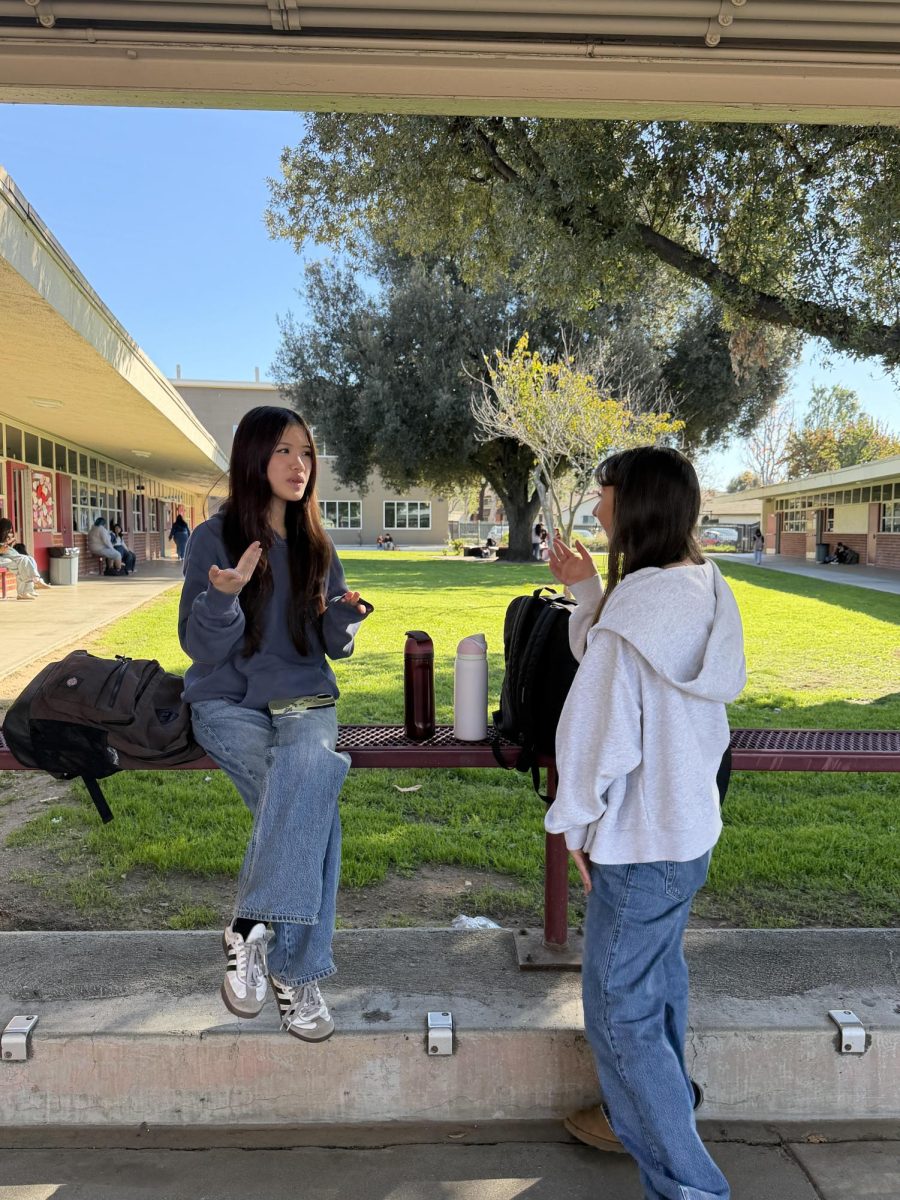
For many students, their behavior may shift depending on who they are with. Going out with friends may look very different from hanging out with parents due to the different levels of respect or trust. Time away from parents can even reveal how teens manage themselves independently and even who their true identity is.
When students go out with friends, they are more outgoing and expressive. Being around friends who share the same energy creates an environment where personalities feel less filtered and laughs are much louder. Friends can provide a space where teens feel comfortable, and being around others their own age allows them to become who they want to be. Around peers, teens may use their own slang, hand gestures and carry themselves with a more open body language.
Freshman Sebastian Fugawa does not have strict parents, but still prefers to talk to his friends about romantic topics and keeps slang and curse words out of his and his parents’ conversations.
“I would rather talk about girls with my friends than parents. I don’t feel comfortable about it, and they don’t know her at all. I think everyone cusses now and uses slang. I don’t think my parents would get it. I, of course, use it with my friends,” Fugawa said.
On the other hand, behavior around parents is more conservative. Teens become more cautious with what they say or how they act. They may be more aware of the expectations or image their parents have of them, and responsibilities such as curfews and schoolwork may be put first around their parents. Parents show more authority, so teens feel like the conversations should be more formal or mature to show a respectful side of themselves.
Even the way students handle arguments with their parents may be very different than the way they handle them with their friends. With friends, they may feel more open to raise their voice, speak freely and not filter any slang or curse words. This can be very different from an argument with a parent, where teens may keep a respectful tone and acknowledge certain boundaries regarding how they speak and what they say to their parents.
This is true for Freshman Yahir Contrera, who always keeps a respectful demeanor when having any disagreements with his mom.
“To my mom, I would start by saying I’m sorry, I really didn’t mean to argue with you earlier that day. That’s my best example if I’m being honest. I just don’t like stressing my mom, and I would rather be cool with her than on her bad side,” Contrera said.
The different types of behavior not only translates to the emotional qualities of a teen but are also seen in action. This can be shown in the form of how a student dresses or changes their wardrobe to be more conservative around parents, versus the freedom of expressing themselves through fashion when they are with friends.

Junior Kim Nguyen feels that although she and her parents share a good relationship, she feels more comfortable when she dresses more conservatively around her parents.
“I don’t wear that much revealing clothes, it’s kind of weird, I don’t want them to be looking and stuff, so I definitely wear more appropriate clothes rather than I would wear in front of my friends,” Kim Nguyen said.
Another reason why students act differently around parents is due to the level of comfortability around their parents. Parents have known their children their entire lives, which means they see emotions or actions that friends have not seen. Teens may show more frustration and stress at home because it is a safer environment where they can express their emotions. A teen may joke around with their friends and act confidently; however, they may open up about their worries or struggles with their parents.
Sophomore Griffey Moncada feels he is comfortable enough to open up and talk with his parents about his feelings more than he is with his friends. He enjoys spending quality time with them to strengthen this bond by going to the movies, the mall and downtown LA.
“I tell my parents more than I would tell my friends because I’m comfortable with my parents, like if I’m with my girlfriend, I told them the first day I met them, so I told her I like this girl, and then my friends. I tell my friends, but I don’t tell them everything,” Moncada said.
Teens and parents may also share different morals and values when it comes to political views. Being raised in different generations may contribute to this, as time passes and different perspectives emerge, allowing teens to choose who and what they believe in.
Sophomore Kourtney Nguyen feels her parents are strict on her and have different views than she and her friends do, because of their older age.
“I’m definitely very woke, very liberal. I can’t vote yet, but I’m a Democrat rather than my dad is MAGA. So I feel less comfortable talking about like political stuff or just stuff in general, I feel like I’m calmer with my friends because I feel like with my parents I tend to have more outbursts, I’m more moody because I’ve been with them my entire life,” Kourtney Nguyen said.
The ability of teens to switch their behavior around parents and friends shows the ongoing process of learning when one can relax or be responsible. It is important to find the balance in being one’s authentic self while also finding respect in one’s behavior.

![Members of this year's prom court after the prom fashion show on April 19 April 19. “The fun part, like homecoming and stuff, that is like the movies, they have prom and stuff, announcing prom queen [and] prom king,” senior Stephanie Perez said.](https://wchsinsight.org/wp-content/uploads/2026/05/40FC9FA0-2E0E-4D8A-A044-BBC0E7A131A0.jpg)