“Backrooms”, directed by 20-year-old Kane Parsons and co-written by Will Soodik, brings the internet craze and horror concept to theaters. Parsons originally created the YouTube series that popularized the concept of an endless office building with yellow wallpaper and the constant hum of fluorescent lights, a liminal space and the horror that is brought with unfamiliarity. While being highly anticipated by critics as well as the audience, the overall pacing and narrative may leave some viewers with a range of perspective of the film.
The concept of the Backrooms originated from an anonymous post to the online platform 4chan in 2019, a still image of the Backrooms. The user described it as “nothing but the stink of old moist carpet, the madness of mono-yellow, the endless background noise of fluorescent lights at maximum hum-buzz and approximately six hundred million square miles of randomly segmented empty rooms to be trapped in.” Following in 2022, Parsons released the YouTube series “Backrooms (Found Footage)” depicting exactly that. Bringing the eerie space to life using Blender, a free 3D software production, at just 16 years old.
The movie begins with Chiwetel Ejiofor (Clark) discovering an entrance to the Backrooms through a wall in the basement of his furniture store, Cap’n Clark’s Ottoman Empire where curiosity motivates him to explore and gather information about the space. Once he actualizes his discoveries about the place by creating hand drawn maps and taking notes of what is dangerous and what isn’t, he shares his findings with his therapist, Renate Reinsve (Dr. Mary Kline), then recruits his furniture store assistant manager, Lukita Maxwell (Kat) and her boyfriend, Finn Bennett (Bobby) to explore and gather video proof of the Backrooms.
The expedition into the Backrooms goes inevitably wrong, resulting in the death of Bobby and Kat. Clark spends an undisclosed amount of time in the Backrooms following their deaths, not because he is lost but because he feels comfortable. He holds Mary hostage in the Backrooms after she ventures out in this space in order to find him and almost encounters an entity that would result in an unpredictable reaction or worse, danger.
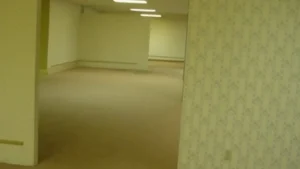
In the “Backrooms,” Clark tells Mary, “For the first time in a long time I feel like I’m right where I’m supposed to be.”
She, as Clark’s therapist, uses her knowledge of his personal life to talk him into releasing her from captivity and furthermore inquiring about his present mental state to assess her approach to the pressuring situation.
This emphasizes how the craze of the Backrooms can envelop a person’s reality and brings to life the idea that people who find themselves forgotten like furniture also find themselves to noclip or fall through solid walls or objects and into these liminal spaces. Once again, Clark underestimates the entities and understanding of the Backrooms, leaving only Mary alive in the final act.
While a portion of the movie when the characters are discovering the space is mostly silence, it further emulates what it truly feels like to find yourself within the eerie walls of the Backrooms, it’s psychological suspense and fear of the unknown that create the story rather than stereotypical horror movie jumpscares and fast moving plot points. The lack of sound, noise or any sign of life for that matter is what defines this place, until there is a sound that has no known origin.
The film uses a found-footage style, referencing the original videos and creating a real, raw immersive experience that draws viewers into the idea and the execution of a liminal space. In an interview with content creator Patrick Tomasso, he mentions “The big light” and its association nowadays with discomfort. This is particularly seen in schools where big fluorescent lights are meant to fill the entire room leaving no space for comfortability. Parsons highlights the fact that in the Backrooms it is only the big light and the overall contribution of the lighting to the filmmaking process as well as the storytelling process is what personalizes the environment to the name and backstory.
“If we want it to be authentic, the goal is to…lean into the natural effects of what happens when every single light is turned on because that’s true to the cultural idea and the symbolism we’re sort of playing into,” Parsons said to Tomasso.