On the fourth Thursday of November or on the second Monday of October, it is tradition for U.S. and Canadian families to celebrate the Thanksgiving holiday. However, the holiday has become controversial as people today feel the holiday disregards the history of European colonization that occurred in the 1600s. While there are negative associations with the holiday such as the widely known, but misleading version of events between the Pilgrims and Natives by providing a romanticized narrative and ignoring the conflicts that took place, it is still possible to celebrate Thanksgiving by separating the holiday from its history.
Thanksgiving was not a national holiday until Dec. 26, 1941, when it was signed into law by former President Franklin D. Roosevelt. It is not celebrated on the original date of the feast between the Pilgrims and Natives, but on every fourth Thursday in November every year as a method of helping the economy by extending the Christmas season.
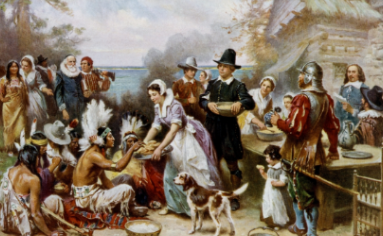
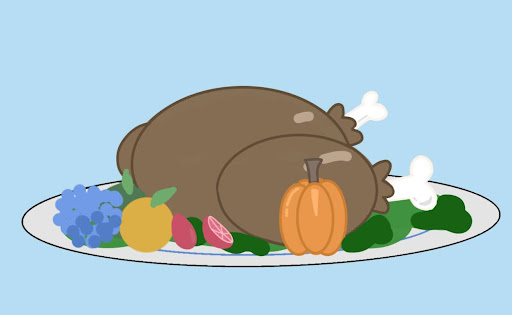
The holiday is associated with the 1621 fall harvest feast at the Plymouth Colony between English settlers and the Wampanoag to celebrate the end of a successful three-day harvest. It is most commonly memorialized with the image of having dinner with family and friends, traditionally being roast turkey with stuffing, mashed potatoes, and a variety of vegetables, whilst being grateful for what they have.
(Ruth Hernandez)
Despite these long-standing traditions, the outlook on Thanksgiving has begun to change to being more focused on the standpoints of Native Americans.
There is the belief by some historians who study Native American history, that Native traditions should be celebrated instead as a remembrance for Thanksgiving’s past as to resist its erasure from history.
According to the article “Rethinking Thanksgiving Celebration: Native Perspectives on Thanksgiving, “The whole history is more complex and includes the Wampanoag voice and perspective that have been largely absent from this narrative. … Learn the significance of Cranberry Day for the Aquinnah Wampanoag and the importance of harvest traditions among Wampanoag communities today.”
On the other hand, some believe that the meaning behind Thanksgiving has changed over time and has developed into something more, being more inclusive as it’s celebrated by people with their own unique traditions in ways like eating foods related to their cultures, and becoming more community-oriented.
“I think as time has come, it’s definitely been more about the family than what was before. It’s more about how should spend time together as just a happy family,” sophomore Jalissa Torresillas, a world history student, said.
Even as people continue to celebrate Thanksgiving, the history behind it should not be completely forgotten, as colonialism in America is still a topic that holds a lot of weight.
“I would say that they’re ignorant a little bit about history. Things are going to be controversial regardless, but we should know why we celebrate and we should know the good, the bad and the ugly,” U.S. history teacher Julia Andino said.
As time passes, there will be those who choose to celebrate the holiday and those who choose not to. Regardless of whatever decision they make when acknowledging it, Thanksgiving has evolved to be a more modern holiday and should be treated as such by allowing people to celebrate the holiday without associating it with its past.
![Members of this year's prom court after the prom fashion show on April 19 April 19. “The fun part, like homecoming and stuff, that is like the movies, they have prom and stuff, announcing prom queen [and] prom king,” senior Stephanie Perez said.](https://wchsinsight.org/wp-content/uploads/2026/05/40FC9FA0-2E0E-4D8A-A044-BBC0E7A131A0.jpg)