While many AI platforms, such as ChatGPT and Google Gemini, are currently blocked on students’ Chromebooks, the district plans to implement more AI into its schools next year, raising concerns among teachers and students. To prepare, the district has created workshops for each school site department for teachers to learn more about AI and its educational tools.
As the district’s AI task force finalizes AI policies for next year, teachers and students have raised concerns, such as AI’s role in academic dishonesty, and worry that making it more accessible will exacerbate the issue. They also bring up their fear that it will undermine critical thinking skills if students overly rely on AI.
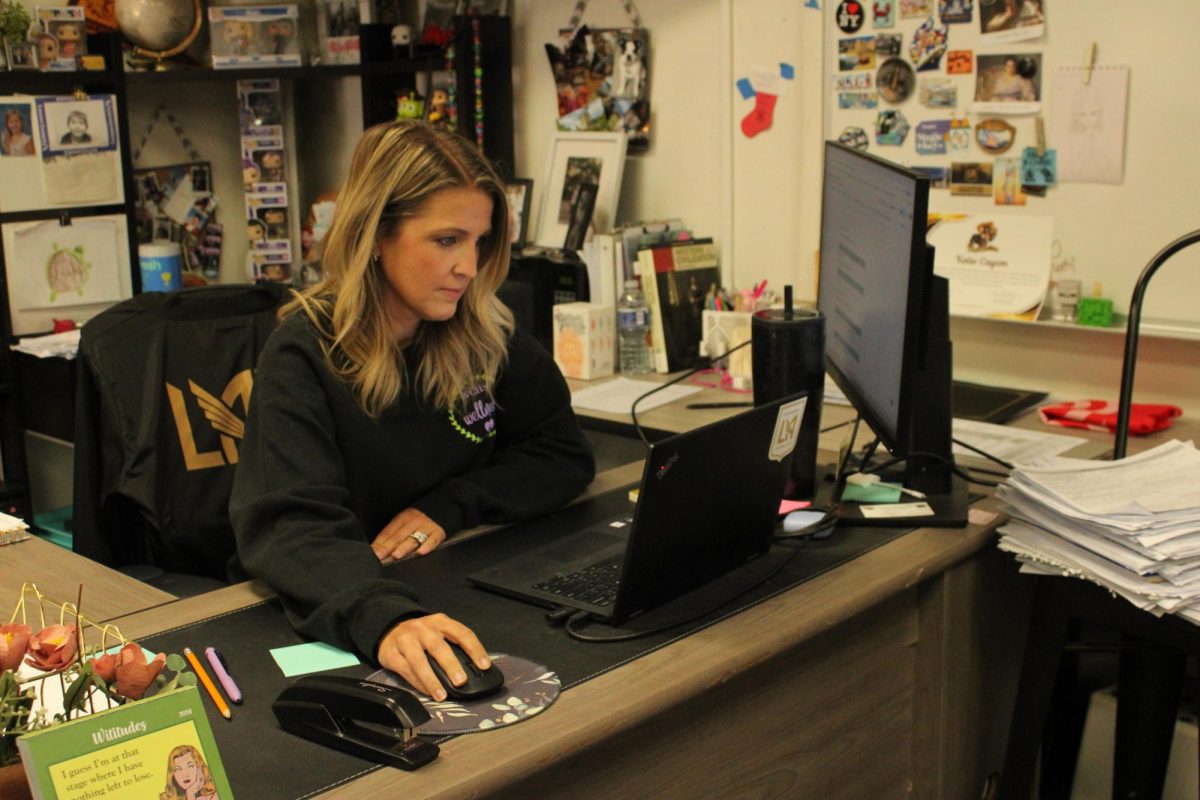
Kathryn Cayem, an AP Seminar and social science teacher, is more concerned about the impact of AI now that its scope has expanded substantially. Cayem also believes it has grown more difficult to regulate AI, so pushing further into technology can be risky.
“It sounds from responses that I’ve gotten and things that I’ve heard, both in this district and in other districts, that there’s no good tools to monitor the use of AI, and that feels irresponsible when we’re talking about giving over AI to students,” Cayem said.
AI checkers have been popularized to verify the originality of student work, but Cayem recognizes their unreliability when using them in her classroom.
“I have had students that have turned in work that I know they have been extremely reflective of and have written and edited with a fine tooth comb that has come up close to 100% AI, and it’s 100% their work, because I’ve watched them do it. And so I think that it is frustrating because there’s no gauge that’s reliable right now to check AI, so you kind of have to, as a teacher, just do your best to block it out as much as you can,” Cayem said.
While Cayem acknowledges her students’ academic integrity, she understands that cheating is also a temptation. Since the introduction of AI has revolutionized the realm of cheating, Cayem is wary of making AI even more accessible for students.
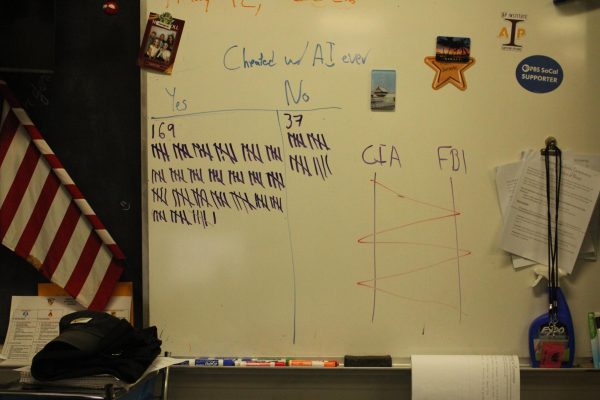
“Students want to do well and want to get good grades, and I think that AI has just exacerbated the problem and given them seemingly unlimited resources to cheat, and made it a lot more accessible to cheat in a much faster capacity… If you have an assignment, you can copy and paste it into AI and have it answered for you, and you’ve never looked at any of it,” Cayem said.
When creating assignments, Cayem keeps potential student use of AI in mind. For example, Cayem has increased her assignments on paper.
“And even if they’re using AI to look up answers, at least if I put it on paper, they’re having to take those answers and read them and write them down. So that doesn’t bother me as much as just an immediate answer that never has to be read, to be able to be translated onto an assignment,” Cayem said.
Cayem also worries that using AI to learn may have negative effects on student thinking, since students can use it to generate information without thinking it through. She worries that the ability to compare and contrast, the competence to contextualize concepts and critical thinking skills, which are necessary for her classes, will be weakened.
Another area that Cayem thinks will be weakened is test scores. Cayem does not think that AI should be implemented in schools since it does not mirror testing environments.
“I think things like SATs and AP testing are not expecting you to use AI on your essays. They’re expecting you to be able to write your essays. They’re expecting you to be able to answer the questions. And if you’re using AI for those throughout the year, you’re not learning how to do it on your own, so you can’t do it in those testing scenarios,” Cayem said.
Cayem views the implementation of AI as a risky decision that could have serious consequences, because even though some of her best students use it to grade the practice essays they write outside of class, not all students utilize AI in this manner, so Cayem believes AI must have limitations.
“I really think that we need to be making decisions based on what we see in classrooms and how we see students actually acting, and not how we want students to act. And as much as we want students to responsibly and productively use AI, to use it as a study tool and a learning tool, most students aren’t doing that. And if we see that, then it’s something we can’t allow when it’s being abused that much,” Cayem said.
Junior Sabrina Alvarado is also worried that AI implementation will lead to loss of critical thinking skills and cause students to stop thinking independently.
“And even though it’s all about, ‘Oh, I just want a good grade’ and stuff like that, it shouldn’t also be like that. The whole reason for school is to actually learn, you know?” Alvarado said.
Alvarado also believes that AI implementation will lower student test scores and harm teachers’ reputations.
“I think it would harm teachers, honestly, because if kids are just using AI and then they get bad scores and stuff like that, it reflects onto the teacher. And the administration would come after them, even though they didn’t really do anything wrong,” Alvarado said.
Principal Charles Park was unavailable for comment at the time of publication.
Sophomore Alexia Ceja Carlos is among the students who use AI as a study tool. In a rigorous schedule filled with honors and AP classes, AI helps Ceja Carlos succeed.
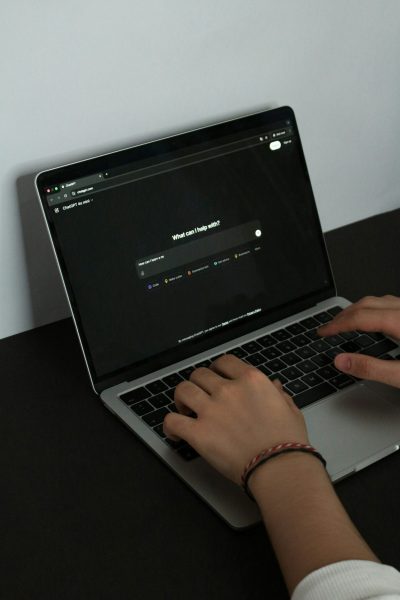
“When Ms. Cayem assigns us essays, like the DBQs and LEQs, she doesn’t always read them immediately. So let’s say we were to type it, I would just insert my essay into this DeAP that she let us use. And then I would just have it, like, ‘Hey, show me what points I got, what points I didn’t.’ Then it would tell me what score I got, and then I would ask it to explain why I didn’t get what I did,” Ceja Carlos said.
Although AI is beneficial for Ceja Carlos in this case, she views it as unethical since one of her friends was a victim of AI being used to generate inappropriate images of her. She also recognizes the issue of students using it to cheat in their classes.
“I think it’s difficult to have an honest relationship with AI, because it’s so easy, and you could just use it to your benefit to help you get good grades. But in the end, it’s not good because you’re not actually learning,” Ceja Carlos said.
Coordinator of Educational Technology Jennifer Crabtree recognizes that AI is constantly evolving, so she hopes schools can evolve alongside it. She believes AI can help teachers incorporate new tools into their classrooms to expand learning and help students prepare for their future, where AI will be present.
“For me, I would hope that not only would student learning be enhanced, but also their preparation for their future. Because, you know, you’re going to graduate and you’re going to go into a world where AI exists, and if we don’t teach you how to use it appropriately, then you won’t be prepared for that world,” Crabtree said.
Crabtree recognizes academic dishonesty as a concern, but believes teaching students how to use AI could help mitigate the issue. She explains how teachers will teach students how to use AI appropriately to protect academic integrity.
“But I feel that if we are teaching not just students, but if we’re teaching everyone to use it appropriately, and how to use it, when to use it, that we can prevent a lot of that. But I don’t think AI is the cause of cheating, necessarily. I think it’s a tool, and like any tool, it can be used for good and it could also be used for bad,” Crabtree said.
The district is currently working on measures to regulate AI implementation.
“We are still working on that, and that information will come later,” Crabtree said.
Crabtree addressed board policies and their emphasis on user responsibility regarding AI. For example, AR 6163.4 states: “The student in whose name district technology is issued is responsible for its proper use at all times.”
BP 6163.4 also states: “The Board intends that technological resources provided by the district be used in a safe and responsible manner in support of the instructional program and for the advancement of student learning. Students shall be allowed to use such technology, including AI technology, in accordance with district policies, including, but not limited to, policies on academic honesty, data privacy, nondiscrimination, and copyright protections.”
“For example, if I were to use AI and I were to just trust what AI said and put it out there as fact, and I was wrong because of that, that’s my responsibility, it’s not AI’s responsibility. Just like you as a student, if you use AI to write a paper and you didn’t check the facts and you turned it in, it’s not AI’s fault, it would be your fault, so the user is responsible,” Crabtree said.
Crabtree is also on the California School Boards Association’s (CSBA) AI Taskforce and has worked with district leadership from all over the state.
“It’s interesting, the outlook that every district in the state has. And everybody is kind of gearing up for this, knowing that this is something that schools are going to have to start embracing, because this is not going away. This is everyone’s future at this point,” Crabtree said.
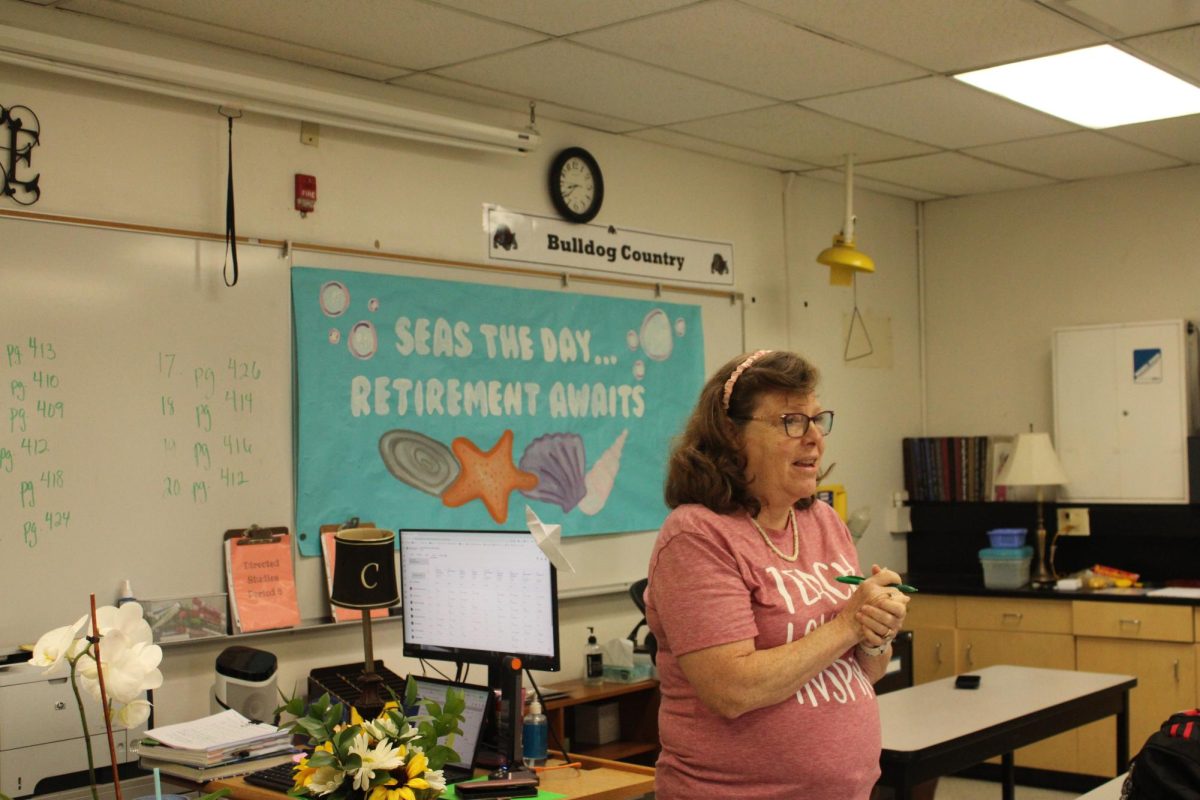
Chemistry and AVID teacher Douglas Race’s class is purely test-based, meaning students’ grades are only impacted by how well they do on tests.
While some teachers may fear student use of AI on assignments to bolster their grade, Race does not grade his students’ homework. In this way, AI has no impact on students’ grades, since they are not credited for assignment completion and do not have access to AI during tests.
“It encourages more ethical use of AI, because the student has to know the material, right? So it’s not just, ‘Do the homework for me.’ It’s, ‘I need to understand what was even going on,’” Race said.
Race believes his way of grading has boosted student motivation to learn the material, since students must understand the curriculum to succeed.
“Yeah, there’s definitely been a big increase in motivation. It’s not necessarily the test that is what is motivating them. It’s the fact that they understand that there’s a connection between the effort they put in and the grade that they receive,” Race said.
Race provides AI as a study tool to help students learn.
“I do interactive notebooks, and so I’ll just attach some of the activities we do with something they can plug into AI and teach them how to do that, so teach them how to use it as a study tool,” Race said.
The implementation of AI is a multifaceted policy with a wide range of impacts on students and their learning. District personnel, teachers and students have all voiced their opinions on the topic, but this issue is not limited to our school district.
AI is becoming increasingly prevalent and influential in society and has immense potential. The rate and scale at which AI has grown have raised questions and concerns; how communities deal with the AI question is a delicate issue that can have significant impacts.