According to the Pew Research Center, a nonprofit organization that researches demographics and global trends, Mexican immigrants are the most common immigrants in the United States. Born in West Covina, junior Tiffany Perez with her family, returned from Mexico, Michoacan Zamora one year ago when she was 15 after experiences with cartel violence.
In Mexico, drug-trafficking is a country-wide issue that has prominently made it an unsafe country to live in due to the resulting violence. With a “Level 4 – Do not travel” to Michoacan, advisory from Travel.State.Gov, the United States official traveling information website, Perez lived in one of the most dangerous areas in Mexico.
According to Border Report, a website dedicated to providing news regarding the US and Mexican, Zamora is the 9th most dangerous city. With the dangers of living there, Perez remained inside her home as much as possible while living next to an apartment complex that had multiple recurrences of murder as a result of narcos, illegal drug dealing .
“There were many narcos around the area, but you could say they were the heads of the drug cartels, that’s why they didn’t interfere; almost nothing ever happened. Near us, but further away, there were some buildings, and there were always deaths there… they were always being killed,” Perez said.
According to Mexico News Daily, “The metropolitan area of Zamora, a city in northwestern Michoacán, recorded 610 murders last year for a per capita murder rate of 196.6 per 100,000 people”, which were likely attributed to the cartels.
Those at the bottom of the cartel hierarchy who flaunted their positions or revealed their relationship with drug trafficking were prone to being killed, which is why according to Perez, frequent deaths in nearby buildings likely occurred.

Eventually, narcos came to her mothers grocery shop to ask for a “cuota”, protection money from the cartels. In Mexico, narcos demand money from shop owners in return for “safety” from them, resulting in the owners paying double their rent amount.
“They asked my mom for protection money about four times and my mom refused to pay,” Perez said.
As a result, they feared the consequences of not paying the cuota, according to Perez. Because she and her siblings were teenagers, they were prone to being recruited by the narcos. Teenaged males are typically recruited to complete the smaller tasks for the “head” of the cartels, such as collecting payments, committing murders and robberies, selling drugs and securing narco territory, where teenaged females are also “recruited”.
“They have a specific time frame for recruiting children, and the girls of a certain age, like 15 or 20, they would take them for prostitution. The boys, they would take them from 10 to 17, I don’t remember the exact ages and they would put them on the streets and send them to do certain orders,” Perez said.
Due to her mother’s refusal to pay and the safety of Perez and her siblings, she eventually closed the store. Because her father’s salary was not enough to sustain Perez and her siblings, they decided to return to the United States.
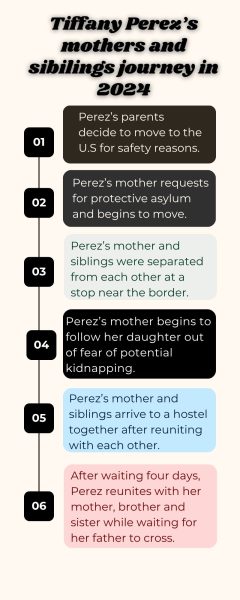
For Perez and her younger sister, their journey back to the US was more straightforward due to being a birthright citizen, and they stayed with her father’s friend while waiting for the rest of her family to arrive.
Her mother began the process by requesting protective asylum, which is when a government gives legal protection to a person who fears persecution in their home country.
When she, Perez’s older sister and brother arrived at a stop near the border, officials separated them since her sister was an adult and her brother was family. Perez’s sister was placed in a black truck with other women, and Perez’s mother feared it was a “false” stop and that they would kidnap and sell her sister into prostitution. According to U.S customs and Border Protection, out of 4.8 million people forced into sexual explotiation, “Women and girls are disproportionately affected by forced labor, accounting for 99% of victims in the commercial sex industry, and 58% in other sectors.”
According to Perez’s account of her mother’s story, she didn’t let her sister go easily and began to look for her by hiding behind the truck to see where it was going. They all eventually arrived in one place where they were told to get inside a white truck by Mexican officials. Though Mexican officials gave directives, certain areas are still managed and ruled by the narcos, leading Perez’s family to hide in the trucks for fear of being searched.
“There was a truck ahead of them, and they searched them thoroughly and realized they were carrying people. Then they heard a gunshot… After they passed further ahead, they realized that someone had been killed and that a girl had been taken out and taken with them. They say that since they have power in that area, if they see a pretty girl, they take her with them,” Perez said.
They eventually arrived at a hostel where they remained for the next four days to wait until they were accepted into the US. Once they crossed the border, Perez reunited with her mother, older sister, and brother while waiting for her father to cross.
Perez’s father attempted to arrive in the US through a “coyote”, a human smuggler who is supposed to make the process “easier” to get into the country. Though it was meant to be easier, it took a month for her father to cross the border.
In his first of four attempts, he went with his “team”, a group who also tried to cross the border. They were found and were forced to flee into the desert. The team ran into different directions, two were caught and returned back to the base in Mexico.
“My dad ran and went off on his own because he had gone through the same thing a long time ago. It’s hard to know the way, but he said that he tried and tried and found his way, and he was almost there, but he got lost and the signal was lost. He turned himself in to immigration because he didn’t know where to go anymore; he was freezing to death,” Perez said.
His other attempts resulted in setbacks and having to return to the house where the coyotes have them stationed to wait for another team. Once a truck arrived to pick them up, Perez’s father was then able to cross the border and reunite with his family.
Despite Perez’s father arrival to the country with the help of a coyote, often, the coyote’s scam, abuse or exploit of their clients goes unnoticed. According to an article by The International Consortium Investigative Journalists (ICIJ), a global nonprofit organization with more than 290 journalists in 100 countries focused on investigating corruption, “some of the Mexican states where trucks smuggling migrants are most frequently detected — and where the most deaths are recorded annually — also have the fewest investigations into human trafficking open.”
According to Simon Pedro Izcara Palacios a sociology professor, “migrant smugglers only have the purpose to rob, kidnap or abandon migrants; that sex trafficking networks, which operate with some degree of deception, are growing; and that more and more migrant smugglers leave this industry, voluntarily or involuntarily, to join drug cartels.”
According to Perez, being in the US has been refreshing and has given her time to enjoy being a teenager due to the feeling of safety as compared to Mexico. However, her biggest struggle is learning English.
(Valeria Aguilar)
Perez’s and her family’s story is one of many, coming to the United States for a better life is not uncommon. She continues to adjust to life in the United States after three years while her older sister attends college, and parents work. Their journey reflects one of many taken by families for better opportunities.