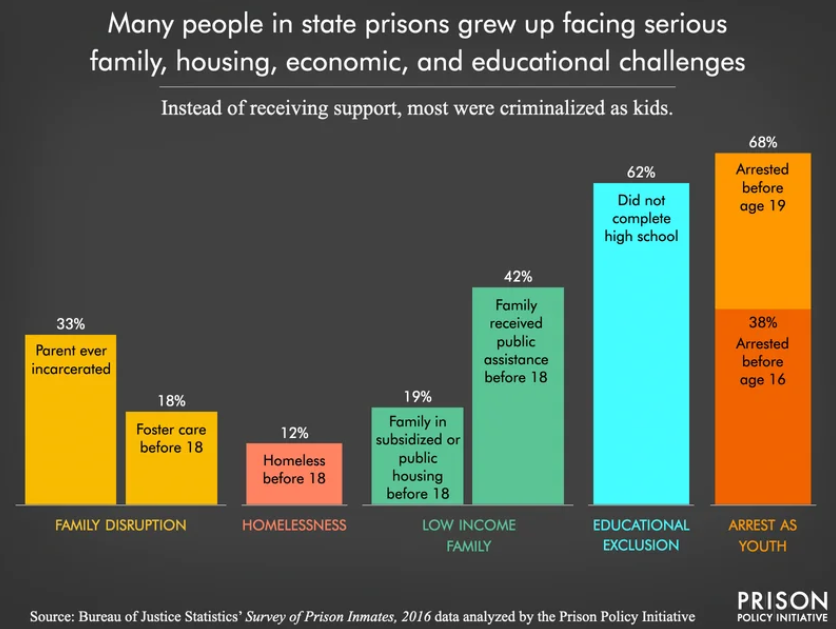
An estimated 2.7 million children in the United States have at least one parent in prison, according to Prison Policy Initiative, a nonprofit organization that researches the impact of mass incarceration. For these children, the absence of a parent can have lasting consequences on emotional well-being, family stability and social development. Research from Science Daily, a popular news website, shows that children with incarcerated parents are more likely to experience anxiety, depression and difficulties in school compared to their peers.
Beyond the emotional impact, families often face financial strain, disrupted routines and limited access to the parent behind bars, such as a lack of presence at special events like birthdays.
Children of incarcerated parents navigate challenges that most of their peers do not. Experts from the National Library of Medicine say that these challenges extend beyond emotions, touching academic performance, peer relationships and long-term identity formation.
Junior Ray Hernandez felt the impact of incarceration through absence rather than memories. Growing up, Hernandez had an absentee father, leaving him to wonder about someone he barely knew.
“Other kids, they have stuff to admire about their dad, or admire their relationship with them, or just want to follow in their footsteps. And for me, I just never had a relationship with my dad, and it’s like I don’t have anything to want to follow…I feel like other people that they had that hero growing up, and I just never had that,” Hernandez said.
Without that connection, Hernandez said, it was often difficult to relate to conversations his peers had about their families. Researchers from JAMA Network, a collection of medical journals published by the American Medical Association, who study parental incarceration say this type of absence can affect a child’s sense of identity, especially during adolescence, when many young people begin looking to family members as role models or sources of support.
For Hernandez, the lack of a relationship with his father also led to complicated emotions toward the parent who was present in his life.
“I didn’t hate my mom or anything, but I just like, kind of in a way, where it was like, why would you get with a guy like that?” Hernandez said.
Family dynamics can become strained when children attempt to understand the circumstances surrounding a parent’s incarceration. According to family psychologists from Child Trends, a nationally leading nonprofit research organization focused on improving the lives of children, adolescents sometimes search for explanations that make sense of their situation, even if those explanations initially place blame on others.
Hernandez explains that his complicated emotions changed after having deeper conversations with his mother about the past. Understanding that she had not known about his father’s behavior helped him understand and move past the resentment he once felt.
Despite that growth, Hernandez expresses the desire to have his questions answered by his father.
“I would probably just say, why he felt like he needed to just leave our family alone, and whether or not he even cared for me, for a second or not before he left and started a new family,” Hernandez said.

While Hernandez experienced a parent who was largely absent from his life, junior Isabella (Nicole) Lopez said her experience growing up involved a different type of instability. Instead of an absent parent, Lopez said her mother moved in and out of her life throughout childhood due to legal trouble.
“Growing up, I don’t think we were close…I more so felt like I was just a burden for her to handle,” Lopez said.
For Lopez, the difference between her family life and those of other students became noticeable early on. Watching classmates interact with their mothers often made her question why her own relationship with her mom felt so distant.
“I was surrounded by a lot of people that had a mom in their life, and I was always very envious of that,” Lopez said.
Researchers from the American Psychological Association say that comparisons like these are common among children who grow up with inconsistent parental support. School environments often highlight differences in family structure through activities such as parent-teacher events.
Around second grade, Lopez’s mother began leaving for extended periods of time, sometimes forcing Lopez to take on responsibilities beyond what most children her age experienced.
“She would be out for multiple times throughout the week, and I had to be left alone to take care of my little brother, Vincent. And I think the more absent she was throughout the weeks, it would turn into months,” Lopez said.
Situations like Lopez’s can lead children to adopt caregiving roles years before mental readiness. Experts from the National Library of Medicine refer to this as parentification, a dynamic where children assume responsibilities typically handled by adults in a household.
While Child Protective Services (CPS) can intervene in cases of neglect, experts from Ohio State University note that the system is often overwhelmed and unable to consistently address every situation. In Lopez’s case, her grandmother provided some stability, but there were still periods where Lopez had to take on responsibilities beyond what most children her age experience.
Family members often step in to provide support when a parent is absent due to incarceration or legal trouble. Lopez explained her grandmother played a major role in raising her and her younger brother, often encouraging them to pursue different paths than the one their mother had taken.
“She saw firsthand how things went down, and I know that she wants me and my brother to be better,” Lopez said.
Although Lopez credits her grandmother for providing stability, she said her childhood experiences still influences how she approaches relationships with others and herself.
“I think it’s affected all my relationships, not only romantically, but also friendship-wise. I feel like it’s changed me as a person. I feel like I try to seek validation from others rather than just normal, healthy relationships,” Lopez said.
Across the country, millions of children experience the same reality as Hernandez and Lopez. While incarceration is meant to serve as punishment for a crime, the impact rarely stops with the person who committed it. For many children, the sentence is something they grow up carrying with them, shaping how they see family, trust and their own future.