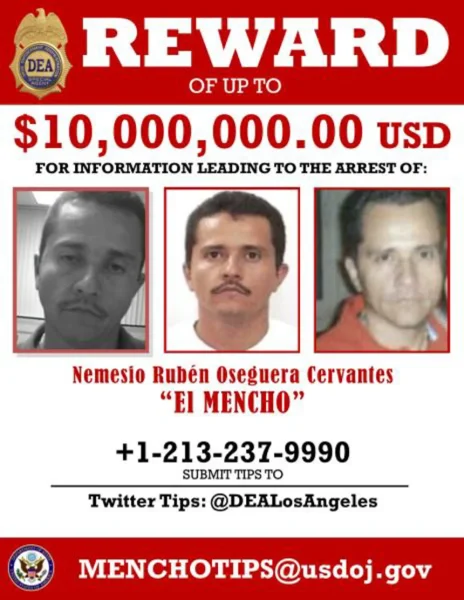
Over the past two decades, Mexico’s cartel violence has continued to rise. On Feb. 22, Mexican security officials killed one of the country’s most wanted cartel leaders, Nemesio Oseguera Cervantes, also known as “El Mencho”. He was born in July 1966 in the state of Michoacán, and according to the US Drug Enforcement Administration (DEA), was involved in drug trafficking since the 1990s.
Cervantes was the leader of the Jalisco New Generation Cartel (CJNG), founded between 2009 and 2010, they emerged from the Milenio Cartel, a drug trafficking organization in Michoacán. Following his death, the U.S. Embassy warned locals and tourists in Mexico to seek shelter, and airlines monitored to determine whether flights were safe.
According to the DEA, The CJNG is one of Mexico’s largest drug trafficking organizations. They also profit from migrant smuggling and extortion. They are also known for attacks against security forces and public officials. Although it has been an ongoing issue, cartels have gained more power, expanding their operations to different states and using military tactics.
According to the Global Conflict Tracker, the Mexican government officially declared war on criminal organizations in 2006 when Felipe Calderon was president; however, the former Secretary of Public Security of Mexico, Genaro Garcia Luna, who worked with Calderon, was later found guilty of taking millions of dollars in bribes from the Sinaloa Cartel. Garcia Luna was sentenced to 38 years in a US prison.
After Calderon’s presidency, cartel groups split and formed their own, bringing widespread crime groups to different areas all over the country. Government officials have faced public distrust over whether they have ties to Mexico’s organized crime groups. Back in 2024, former Mexican President Andres Manuel Lopez Obrador denied allegations that people close to him took money from drug traffickers before his election in 2018.
According to AP News, Obrador stated during his morning press conference on Feb. 22, 2024, “It’s all completely false. The U.S. government is going to have to address this.’ Former U.S. National Security Council spokesman John Kirby said, ‘There is no investigation into President López Obrador.”
The death of the CJNG leader has brought more insight into Mexico’s cartel crisis. On the day following Cervantes’ death, schools in the surrounding areas postponed classes. According to the Los Angeles Times, Mexico’s president, Claudia Sheinbaum stated that “The detention of a suspected criminal with an arrest warrant can generate this type of circumstance, but we want peace, not war.”
Government officials have been clearing the streets, such as roadblocks and burned cars, since Cervantes’ death, but locals suspect there will be future outbreaks of violence due to arguments over new cartel leadership, especially with the World Cup approaching, where Mexico City, Monterrey and Guadalajara are all expected to host upcoming matches.
According to ESPN, Gianni Infantino, International Federation of Association Football (FIFA’s) president, stated, “we are monitoring the situation in Mexico these days, but I want to say from the outset that we have complete confidence in Mexico, in its president, Claudia Sheinbaum, and in the authorities, we are convinced that everything will go as smoothly as possible.”