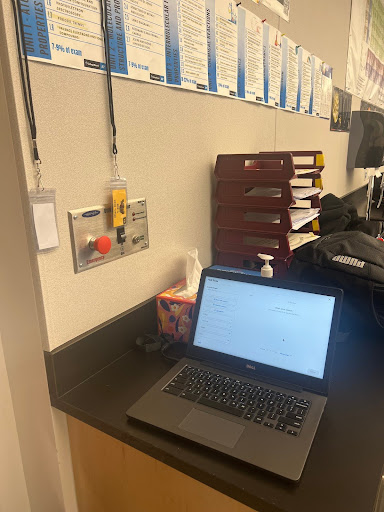
Last month, a new rule was implemented by principal Charles Park that requires students to wear a lanyard when going to the restroom when they already have to create a Minga hall pass. It was done with the purpose of ensuring the safety of students on campus by allowing security to be able to have an easier time identifying which students were permitted to be outside of class without having to check Minga. This is on top of students no longer being able to take their phones with them to the restroom, there have been mixed opinions about these new rules because of the inconveniences they cause students.
This was not the only reason the lanyards were created; according to Park, they were also designed with the health and safety of students in mind as fentanyl has been circulating around schools nationwide.
“In 2012, California suffered 82 tragic deaths attributed to fentanyl overdoses, and last year that number jumped to more than 6,000. Fentanyl deaths accounted for more than 80 percent of all drug-related deaths among California’s young people in 2021,” the California Department of Education (CDE) stated.
According to Park, the fentanyl situation on campus needed to be addressed.
“The other challenge we have is fentanyl on campus, on any campus, and we know that the response time that the student comes into contact with fentanyl is important. So our training to our security team and our administration is to make sure that we are always checking bathrooms as much as we can. … . So the lanyards are only going to help us,” Principal Charles Park said.

(Ruth Hernandez)
Park said a student without a lanyard in the hallway won’t result in any disciplinary action other than a verbal reminder by security or the teacher writing a referral if the student refuses, counting as a citizenship infraction which could result in a seating change for the student in class, to having parent contact, according to the West Covina Highschool student handbook for 2025-2026.
“A teacher can write a referral, but in on our end, I don’t think we’ve actually had to, unless it’s so egregious. I don’t think we stop students and ask ‘do you have a lanyard? Because if you don’t you’ll get a lunch detention,’” Park said.
While the lanyards were created for safety and convenience, there are students who do not view them in the same manner and believe them to be more of an inconvenience.
“I really, really dislike Minga, and all of this because for one of my periods, I’m a TA, it’s quite annoying having to get out like, ‘Oh, where’s his pass?’, ‘Oh, where’s this?’ When I’m out to go get copies and stuff, security gets mad that they see me, like two times in the same period so it’s kind of just annoying having to reassure them every single time, but it’s not even their fault,” teacher assistant Jaymee Otero said.
There are other concerns about the cleanliness of the lanyards, considering that all students who leave class during class time will be coming in contact with them.
“It’s unsanitary and uncomfortable because it’s not washed or anything, and all people just wear it,” freshman Christina Xu said.
Park said there are currently no plans for more rules to be created for students when exiting class during instructional time and there is a possibility that if the safety concerns on campus during class time begin to subside, then the restrictions may begin to loosen.
“I don’t foresee anything else that we need to be doing. I think at the end, it’s the other way around. I think we could do a better job educating our students and that’s give and take. We know it’s not everyone, it’s a small number of kids that have behavior issues,” Park said.